
EPF vs NPS vs PPF: The Three-Way Retirement Comparison for Salaried Indians
Step-by-step comparison of EPF, NPS, and PPF — contributions, interest rates, lock-in, withdrawal rules, tax treatment at maturity, and how to combine all three for a robust retirement plan.


Disclaimer: This article is for educational purposes only and does not constitute financial advice. The author is not a SEBI-registered advisor or certified financial planner. Please consult a qualified professional before making any investment or tax decisions.
This article is for educational purposes only and does not constitute financial advice. Rates and rules are subject to change; verify current figures at EPFO, PFRDA, and the Ministry of Finance websites.
For most salaried employees in India, EPF is mandatory, PPF is the default voluntary savings choice, and NPS is "something HR mentioned once." All three are government-backed retirement instruments with significant tax advantages. All three work very differently. And combining them correctly can make a substantial difference to retirement wealth.
This guide compares all three on every dimension that matters, then shows how they fit together.
Step 1: Understand how each works
EPF (Employees' Provident Fund)
Mandatory for all employees earning below ₹15,000/month (though most employers apply it to all staff). Both employer and employee contribute 12% of basic salary + DA monthly.
- Employee contribution: 12% of basic — goes entirely to EPF
- Employer contribution: 12% of basic — split as 3.67% to EPF, 8.33% to EPS (Employee Pension Scheme)
- Interest rate FY2025-26: 8.25% p.a. (declared by EPFO, compounded annually) — see when this year's interest actually gets credited
- Managed by: EPFO (Employees' Provident Fund Organisation)
NPS (National Pension System)
Voluntary for private sector employees (mandatory for central government employees joining after 2004). Contributions invest in market-linked funds — equity (E), corporate bonds (C), and government securities (G).
- Contribution: Any amount; 80CCD(1B) deduction available on ₹50,000 beyond 80C limit
- Returns: Market-linked; NPS E-class (equity) approximately 11–13% CAGR historically
- Managed by: PFRDA-registered fund managers (SBI, LIC, HDFC, ICICI, Kotak, UTI, Axis)
PPF (Public Provident Fund)
Fully voluntary, open to everyone (including self-employed). Fixed government-set interest rate, reviewed quarterly.
- Contribution: ₹500 minimum to ₹1.5 lakh maximum per year
- Interest rate: 7.1% p.a. (unchanged since April 2020, compounded annually) — see current PPF and NSC small savings rates for the full quarterly picture
- Managed by: Post offices and designated banks (SBI, HDFC, ICICI, Axis etc.)
Step 2: Compare the key dimensions
| Dimension | EPF | NPS (Tier I) | PPF |
|---|---|---|---|
| Mandatory / voluntary | Mandatory (most salaried) | Voluntary | Voluntary |
| Who contributes | Employee + employer (both 12%) | Employee only (+ employer if corporate NPS) | Individual only |
| Interest / return | 8.25% (FY26, fixed by EPFO) | Market-linked (~11–13% equity) | 7.1% (government-set) |
| Return guarantee | ✅ Fixed rate | ❌ Market risk | ✅ Fixed rate |
| Lock-in | Until retirement (partial withdrawal allowed) | Until age 60 | 15 years |
| Tax on contribution | 80C (employee share) | 80CCD(1)+80CCD(1B) | 80C |
| Tax during accumulation | Tax-free interest | Tax-free growth | Tax-free interest |
| Tax at maturity | EEE (fully exempt if withdrawn after 5 years service) | 60% lump sum tax-free; 40% annuity taxed as income | EEE (fully exempt) |
| Partial withdrawal | Allowed for housing, medical, education after conditions | Allowed after 3 years for specific purposes (max 25%) | From Year 7 (partial) |
| Loan against corpus | ✅ (up to 50% of own contribution, after 5 years) | ❌ | ✅ (Year 3–6, 1% above PPF rate) |
| Premature closure | Only for specific reasons (home purchase, illness) | Premature exit: 80% to annuity, 20% lump sum | After 5 years for medical/education (penalty applies) |
| Minimum investment | 12% of basic (automatic) | ₹1,000/year | ₹500/year |
| Maximum annual benefit | No upper limit (employer share adds up) | ₹50,000 extra deduction under 80CCD(1B) | ₹1.5 lakh (per 80C) |
Use the Stax EPF Calculator, NPS Calculator, and PPF Calculator to run your own projections.
Step 3: Understand the tax treatment in detail
All three instruments offer EEE or near-EEE status, but with important differences at the withdrawal stage.
EPF: True EEE — contribution deductible (80C), interest tax-free, maturity/withdrawal fully tax-free provided the employee has completed 5 continuous years of service. If withdrawn before 5 years, both employer's contribution and interest become taxable. TDS is deducted at 10% if PAN is provided (30% without PAN) on premature withdrawals.
NPS: Near-EEE — contribution deductible (80CCD), growth tax-free, but at retirement: 60% of corpus can be withdrawn as a tax-free lump sum, while the remaining 40% must purchase an annuity and the annuity income is taxable as per your income slab. This makes NPS's effective tax treatment slightly worse than EPF and PPF at the final stage.
PPF: True EEE — contribution deductible (80C), interest tax-free, maturity fully tax-free. No conditions on service years. Available to self-employed, which EPF is not.
Step 4: Run the 30-year numbers
Assumptions: ₹20,000 basic salary (for EPF), ₹10,000/year each to NPS and PPF, 30-year horizon.
| Instrument | Annual contribution | Assumed return | Pre-tax maturity corpus |
|---|---|---|---|
| EPF (employee only) | ₹28,800/yr (12% of ₹20K × 12) | 8.25% | ~₹37.7 lakh |
| EPF (employee + employer) | ₹57,600/yr (both sides) | 8.25% | ~₹75.4 lakh |
| NPS (₹10,000/yr) | ₹10,000/yr | 11% (equity) | ~₹22.9 lakh |
| PPF (₹10,000/yr) | ₹10,000/yr | 7.1% | ~₹10.2 lakh |
For ₹1.5 lakh/year invested across all three at maximum:
- PPF at 7.1% → ₹1.53 crore over 30 years
- EPF (if basic salary allows ₹1.5L annual) at 8.25% → ₹1.93 crore over 30 years
- NPS equity at 11% → ₹3.44 crore over 30 years (pre-tax; post-tax ~₹2.9 crore after annuity and LTCG)
Step 5: Combine them correctly
The three instruments are not competitors — they are complementary layers:
Layer 1 — EPF (mandatory floor) Let it run. Don't withdraw prematurely. Keep job switches clean by transferring via UAN. At 8.25% EEE, EPF is the best risk-free return available in India.
Layer 2 — PPF (safe voluntary savings) Open a PPF account if you don't have one. Deposit ₹1.5 lakh/year to exhaust the 80C limit (alongside EPF employee contribution — both count toward 80C). PPF provides liquidity (loans from Year 3, partial withdrawal from Year 7) that EPF doesn't.
Layer 3 — NPS (growth + extra tax deduction) If you are in the old tax regime and the 30% bracket, add ₹50,000/year to NPS Tier I — purely for the 80CCD(1B) deduction. The ₹15,600 annual tax saving reinvested is powerful over 20+ years. Select the Active Choice with 75% E-class (equity) for maximum growth. If you're in the new tax regime, the 80CCD(1B) benefit is unavailable — use the ₹50,000 for equity mutual funds instead. Our NPS vs mutual funds comparison goes deeper on this trade-off.
Layer 4 — Equity mutual funds (beyond these limits) Once EPF + PPF + NPS limits are maximised, direct additional retirement savings into index funds or flexi-cap equity funds. No lock-in (post-3-year ELSS — see our ELSS vs PPF 80C comparison), no annuity obligation, maximum compounding.
By Grishma, personal finance writer at Stax Tools. EPF interest rate for FY2025-26 as declared by EPFO. NPS returns are historical CAGR and not a guarantee of future performance.
Sources & methodology
- EPFO — Circulars — EPF interest rate notification for FY2025-26 (8.25%)
- PFRDA — Annual Reports — NPS Trust and pension fund performance data
- Department of Economic Affairs — Small Savings interest rate notifications — PPF interest rate notification
- Income Tax Department — Income-tax Act, 1961 (Section 80C) — statutory text underlying the EPF/PPF/NPS tax provisions (Sections 80C, 80CCD, 10(11), 10(12))
Grishma
Finance Content Writer
Grishma writes about personal finance, investing, and tax planning for Indian readers — translating complex regulatory changes into clear, actionable guidance.
More by Grishma →Tools mentioned in this article
- EPF Calculator
Estimate Employee Provident Fund corpus at retirement. Accounts for monthly contributions, annual hikes, and current EPF interest rate.
- NPS Calculator
Calculate NPS corpus, 60% lump sum, and estimated monthly pension at retirement.
- PPF Calculator
Calculate PPF maturity amount and year-by-year balance at 7.1% with EEE tax benefit.
Related reading
 NPS vs Mutual Funds for Retirement: Which Builds More Wealth in 2026?Side-by-side comparison of NPS and mutual funds for long-term retirement investing — returns, tax benefits under 80CCD, lock-in, annuity obligation, withdrawal rules, and a verdict for different investor profiles.6 min read
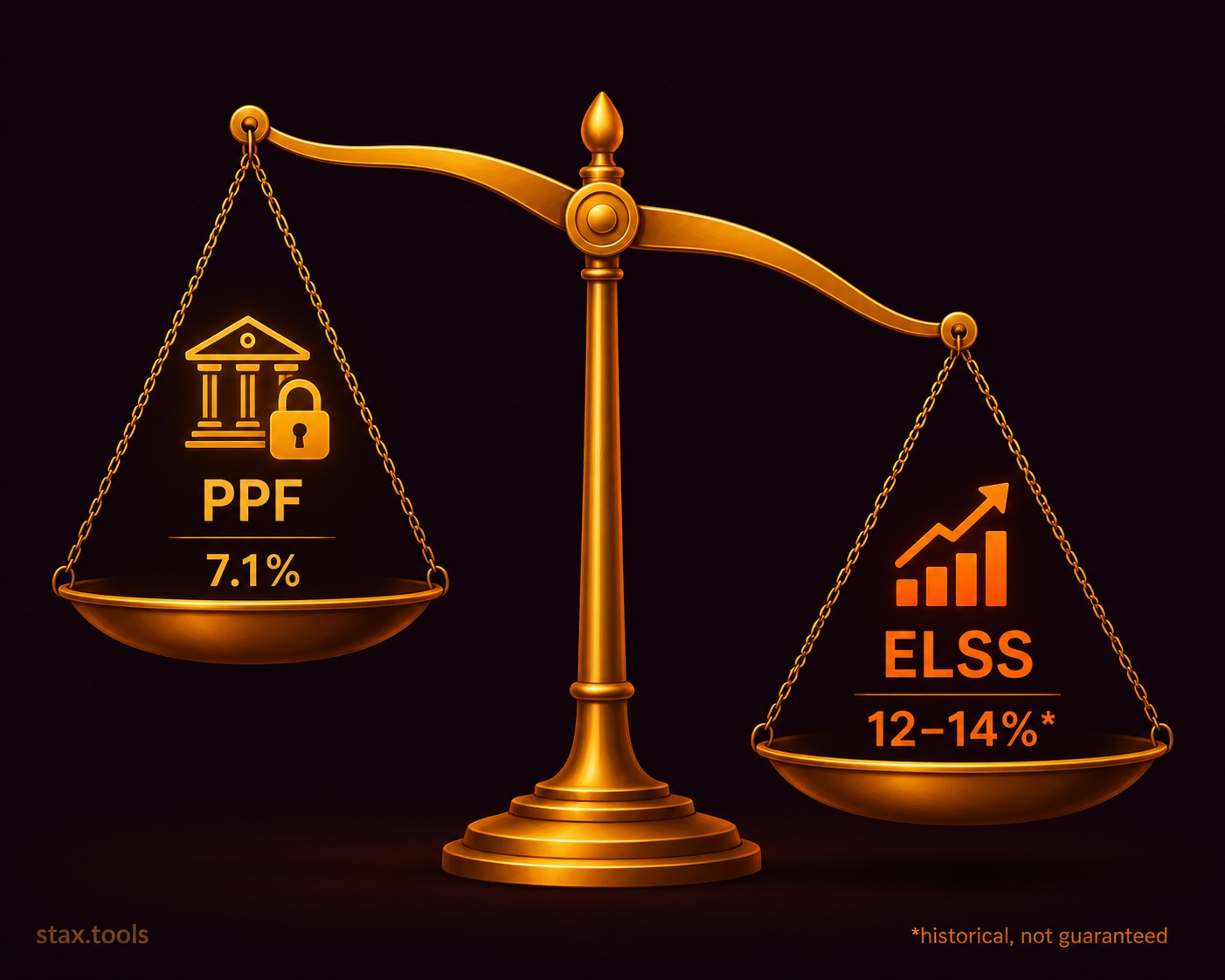 ELSS vs PPF: Which Section 80C Option Actually Wins in FY2026-27?With RBI cutting rates 50 bps in 2025–26 and PPF at 7.1%, the ELSS vs PPF calculus has shifted. Here's which ₹1.5 lakh 80C investment makes more sense now — with 10-year return data, lock-in comparison, and tax treatment side by side.6 min read
 EPF Interest Rate 2025-26 Stays at 8.25%: When It Gets Credited and What It's WorthEPFO has kept the EPF interest rate at 8.25% for FY 2025-26 for the second year running. Here's when the interest will be credited to your account, how the calculation works, and whether your EPF is actually earning what you think it is.8 min read
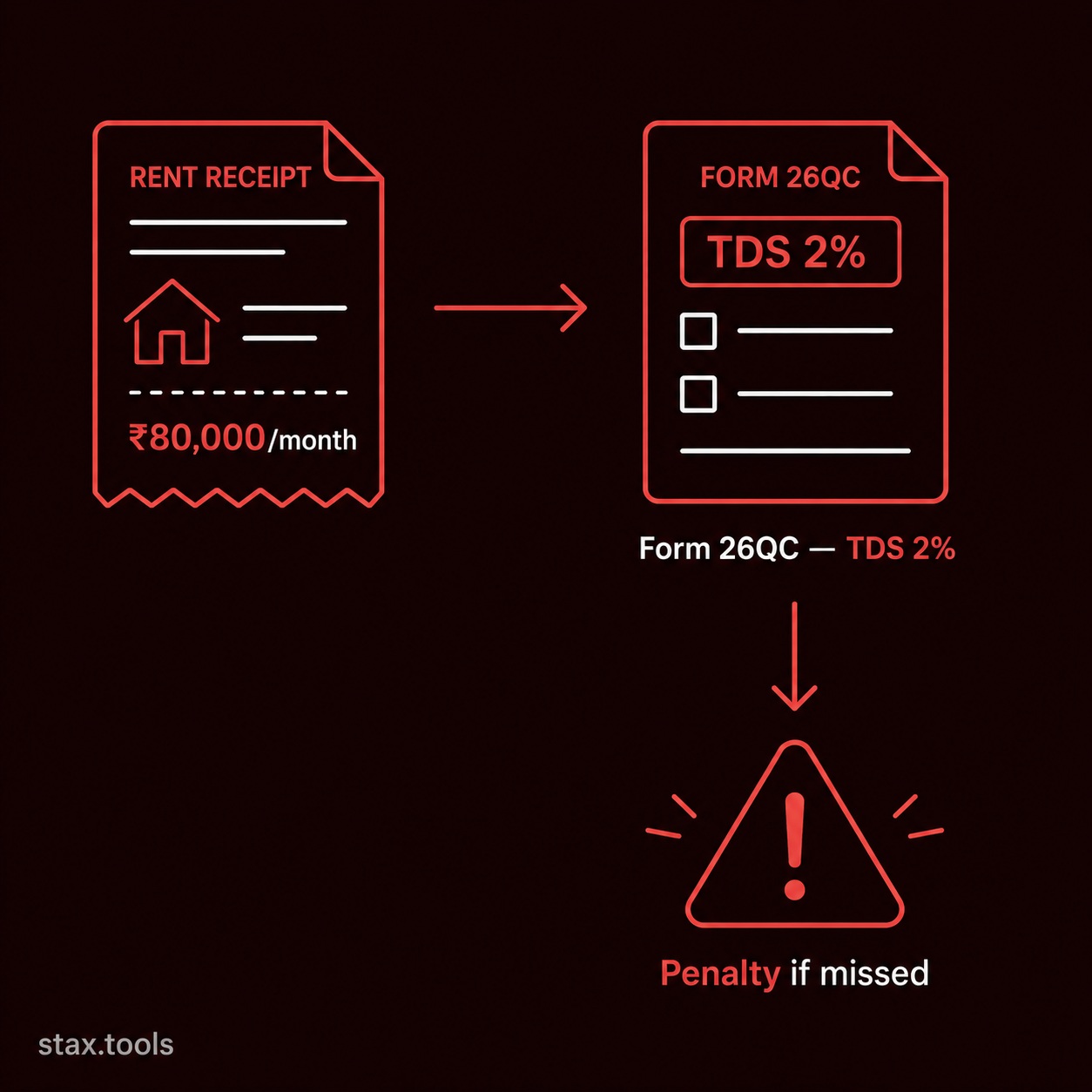 TDS on Rent Above ₹50,000: What Tenants Must Do Before the DeadlineMost tenants believe TDS on rent is the landlord's problem. It isn't. If you pay monthly rent above ₹50,000, the obligation to deduct, deposit, and file falls entirely on you — and the penalties for non-compliance are steep.5 min read
Found this useful?
Browse 235+ free privacy-first tools — no login, no uploads, instant results.